95V3-1.jpg)


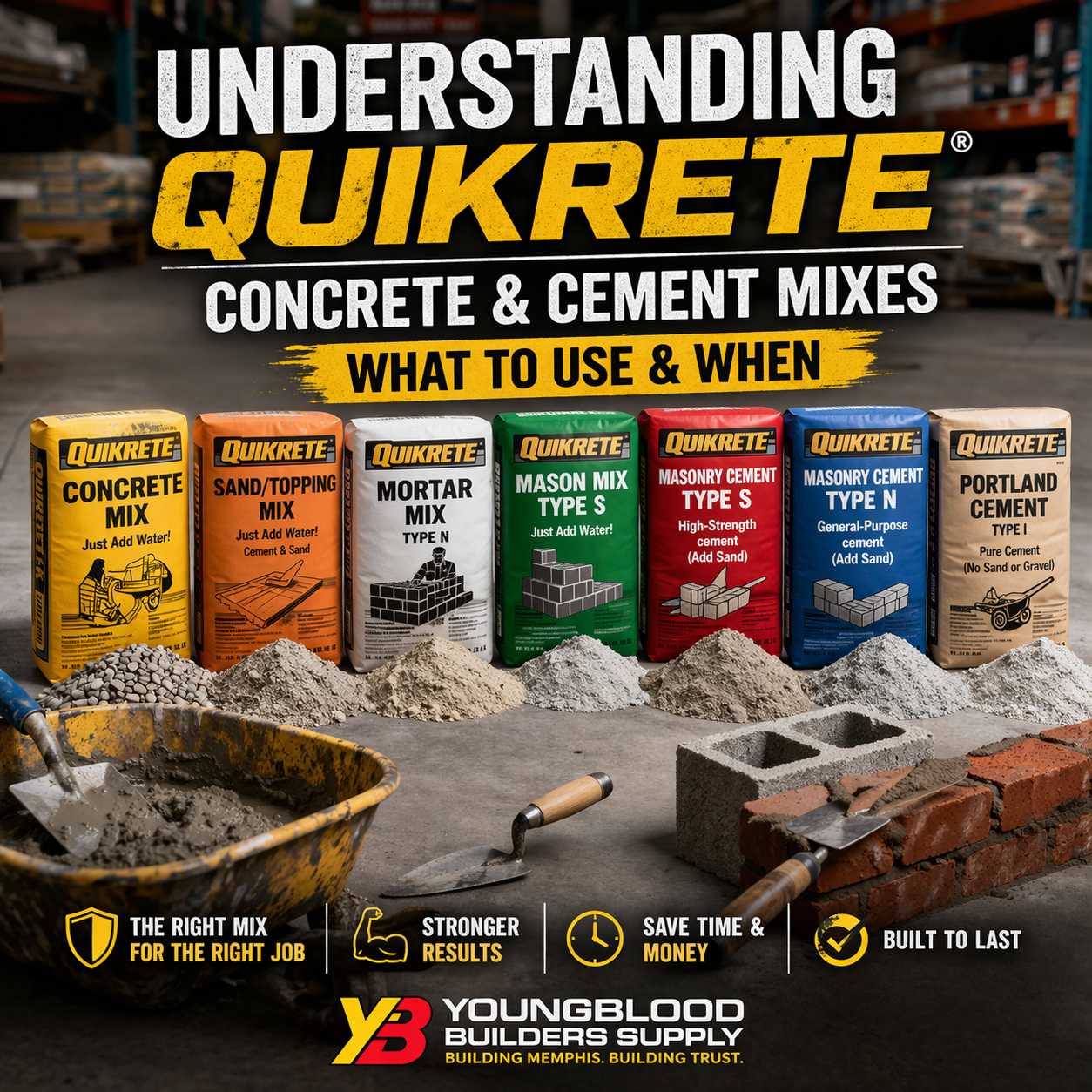
What to Use — and When


One of the most common questions we get at Youngblood Builders Supply is:
“Which Quikrete mix do I actually need?”
If you grab the wrong one, you can end up with cracking, weak joints, or a job that just doesn’t hold up. So here’s a simple, no-BS breakdown of the most common Quikrete products—and when to use each one.
Concrete Mix
Fast-Setting Concrete Mix
What it is: Cement + sand + gravel
Best for: Slabs, footings, sidewalks, posts
- This is your go-to structural mix
- The gravel gives it strength and durability
- Ideal for anything that needs to hold weight
Use this when: You’re pouring something thick and load-bearing
Sand Mix (Topping Mix)
What it is: Cement + sand (no gravel)
Best for: Thin repairs, leveling, shower pans
- Smoother and easier to finish than concrete
- Designed for thin applications (under 2")
- Great for resurfacing existing concrete
Use this when: You need a smooth finish—not structural strength
Don’t use for: Driveways, slabs, or anything structural
Mortar Mix
What it is: Bonding mix for masonry
Best for: Brick, block, stone
- Sticky and workable
- Designed to hold masonry units together
Use this when: You’re laying brick or block
Don’t use for: Slabs or structural pours
Mason Mix Type S
What it is: High-strength mortar mix
Best for: Foundations, retaining walls, structural masonry
- Stronger bond than standard mortar
- Holds up in below-grade or load-bearing applications
Use this when: The wall carries weight or is underground
Masonry Cement Type S
What it is: Cement only (you add sand)
Best for: Mixing your own high-strength mortar
- Gives you control over your mix
- Preferred by pros doing large jobs
Use this when: You know your mix ratios and want flexibility
Masonry Cement Type N
What it is: Lower-strength masonry cement
Best for: Brick veneer, above-ground walls
- Easier to work with than Type S
- More flexible (less cracking in lighter applications)
Use this when: You’re doing general-purpose or decorative masonry
Portland Cement
What it is: Pure cement (no sand, no gravel)
Best for: Mixing your own concrete or mortar
- Total control over strength and mix design
- Used by experienced builders
Use this when: You’re building your own mix from scratch
Important: This is NOT ready-to-use—you must add sand and/or gravel
Quick Comparison (Simple Version)
- Concrete Mix → Structural (has gravel)
- Sand Mix → Smooth, thin repairs
- Mortar Mix → Brick/block bonding
- Mason Mix Type S → High-strength masonry
- Masonry Cement Type S → Custom strong mortar
- Masonry Cement Type N → General masonry
- Portland Cement → Base ingredient only
Pro Tip (From the Yard)
Most DIY mistakes come down to this:
Using mortar where concrete is needed—or vice versa.
If it needs strength → Concrete Mix
If it needs bonding → Mortar / Mason Mix
If you’re customizing → Portland or Masonry Cement
Need Help Choosing?
At Youngblood Builders Supply, we help folks get this right every day. Whether you're pouring a slab, setting posts, or laying brick—we’ll point you to the right product the first time.
Stop by or give us a call—we’ve got you covered.
What to Use — and When
One of the most common questions we get at Youngblood Builders Supply is:
“Which Quikrete mix do I actually need?”
If you grab the wrong one, you can end up with cracking, weak joints, or a job that just doesn’t hold up. So here’s a simple, no-BS breakdown of the most common Quikrete products—and when to use each one.
Concrete Mix
Fast-Setting Concrete Mix
What it is: Cement + sand + gravel
Best for: Slabs, footings, sidewalks, posts
- This is your go-to structural mix
- The gravel gives it strength and durability
- Ideal for anything that needs to hold weight
Use this when: You’re pouring something thick and load-bearing
Sand Mix (Topping Mix)
What it is: Cement + sand (no gravel)
Best for: Thin repairs, leveling, shower pans
- Smoother and easier to finish than concrete
- Designed for thin applications (under 2")
- Great for resurfacing existing concrete
Use this when: You need a smooth finish—not structural strength
Don’t use for: Driveways, slabs, or anything structural
Mortar Mix
What it is: Bonding mix for masonry
Best for: Brick, block, stone
- Sticky and workable
- Designed to hold masonry units together
Use this when: You’re laying brick or block
Don’t use for: Slabs or structural pours
Mason Mix Type S
What it is: High-strength mortar mix
Best for: Foundations, retaining walls, structural masonry
- Stronger bond than standard mortar
- Holds up in below-grade or load-bearing applications
Use this when: The wall carries weight or is underground
Masonry Cement Type S
What it is: Cement only (you add sand)
Best for: Mixing your own high-strength mortar
- Gives you control over your mix
- Preferred by pros doing large jobs
Use this when: You know your mix ratios and want flexibility
Masonry Cement Type N
What it is: Lower-strength masonry cement
Best for: Brick veneer, above-ground walls
- Easier to work with than Type S
- More flexible (less cracking in lighter applications)
Use this when: You’re doing general-purpose or decorative masonry
Portland Cement
What it is: Pure cement (no sand, no gravel)
Best for: Mixing your own concrete or mortar
- Total control over strength and mix design
- Used by experienced builders
Use this when: You’re building your own mix from scratch
Important: This is NOT ready-to-use—you must add sand and/or gravel
Quick Comparison (Simple Version)
- Concrete Mix → Structural (has gravel)
- Sand Mix → Smooth, thin repairs
- Mortar Mix → Brick/block bonding
- Mason Mix Type S → High-strength masonry
- Masonry Cement Type S → Custom strong mortar
- Masonry Cement Type N → General masonry
- Portland Cement → Base ingredient only
Pro Tip (From the Yard)
Most DIY mistakes come down to this:
Using mortar where concrete is needed—or vice versa.
If it needs strength → Concrete Mix
If it needs bonding → Mortar / Mason Mix
If you’re customizing → Portland or Masonry Cement
Need Help Choosing?
At Youngblood Builders Supply, we help folks get this right every day. Whether you're pouring a slab, setting posts, or laying brick—we’ll point you to the right product the first time.
Stop by or give us a call—we’ve got you covered.